Blog
The Advantages of Investing in Solar Panels

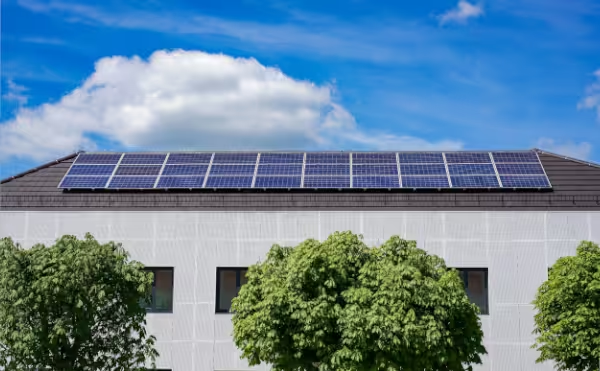
As the global community unites in the pursuit of carbon neutrality, the photovoltaic (PV) industry has experienced rapid and remarkable growth. By the end of 2023, solar panel installations significantly exceeded initial projections. With recent market trends offering even more encouraging news—such as the steadily decreasing cost of crystalline silicon wafers—there has never been a better time to invest in solar energy.
This comprehensive guide explores the key advantages of photovoltaic solar panels and highlights the essential factors to consider before making a solar energy investment.
The Advantages of Investing in Solar Panels
1. Reduce Electricity Bills
Solar panels absorb sunlight and convert it into Direct Current (DC). A solar inverter then transforms this DC power into Alternating Current (AC). A portion of this AC power is used to run your appliances, while the remaining portion is stored in a battery for backup. By reducing your reliance on the utility grid, you can drastically lower your monthly electricity costs. Furthermore, homeowners can enhance their financial returns by taking advantage of various government incentives and net-metering schemes.
2. Energy Security During Power Outages
When paired with lithium batteries in an off-grid solar system, solar panels provide unmatched energy security, particularly during grid disruptions. Off-grid systems with lithium batteries are becoming increasingly popular due to the continuous advancement and decreasing cost of battery technology. These systems guarantee a steady power source, ensuring your home or business remains resilient against power interruptions.
3. Increased Property Value
Investing in a solar power system is proven to increase your property's value. Environmentally conscious and investment-minded buyers frequently seek out homes equipped with solar systems, recognizing the long-term dependable power supply and environmental benefits they offer.
4. Environmental Responsibility
As a renewable energy source, solar power helps achieve carbon neutrality and minimizes environmental impact by reducing reliance on fossil fuels. Solar energy is a clean, sustainable, and energy-saving alternative that leaves a much smaller carbon footprint.
5. Aligning with Future Trends
Investing in solar energy is a long-term decision that aligns with global renewable energy trends. By generating your own electricity, you contribute to a more environmentally friendly future and reduce global dependence on fossil fuels.
Things to Consider When Investing in Solar Panels
While the benefits are clear, careful planning is required for a successful investment.
1. Selection of the Solar Panel System
When deciding to invest in a solar system, you must first analyze how much electricity your home or business consumes. Remember, solar energy is only generated during daylight hours, and the size of your system determines how much power it can produce. You need to understand which appliances you plan to run, their power consumption, and their operating duration. Never purchase a solar system solely for financial gain without proper sizing, as it will be ineffective.
2. Finding a Reliable Solar Solution Provider
Finding a professional solar supplier is crucial. Be highly cautious of providers offering incredibly low prices; such deals often lead to frustrating after-sales problems.
Here are key factors to consider when evaluating a solar quote:
Beware of prices that seem too good to be true. They usually create major issues after purchase.
Look for experience and reliability. Solar panels last a long time, so you need a trustworthy supplier that can provide complete after-sales support.
Prioritize quality. High-quality solar panels and inverters are more cost-effective and last significantly longer than cheaper alternatives.
Ensure they offer clear communication. Your provider should be able to easily answer all your questions.
Think ahead. Consider your current and future power needs, especially as lithium solar systems become increasingly useful and accessible.
3. Solar Panels Are Only Part of the System
While solar panels are the most visible component, they are only one part of a complete solar system. Because most household appliances cannot directly use DC power, the following equipment is also required:
Solar Inverter: Converts DC power into AC power to run your home appliances.
Solar Batteries: Store excess DC power so you can use the inverter to power your home at night or during an outage.
Solar Brackets: Used to secure solar panels to your roof, usually made of aluminum. Your installer will adjust the angles to maximize sunlight exposure.
Monitoring Systems: Many modern systems include mobile-accessible monitoring to measure power generation and usage, helping you get the most out of your setup.
The Crucial Role of Panel Placement
The location and angle of your solar panel installation are critical. Depending on your property’s location and sunlight exposure, panels may need to be fitted at specific angles.
A south-facing solar panel generally collects the most solar energy throughout the day. However, East and West-facing panels also play important roles:
East-facing panels collect the most energy in the morning.
West-facing panels collect the most energy in the afternoon.
Your solar installer should advise on your power needs at different times of the day to determine the best configuration. Keep in mind that a system with the maximum number of panels is not always the best choice. Maximizing the efficiency of your panels to generate the most electricity will reduce your overall investment costs and lower your electricity bills more effectively.
Conclusion
In conclusion, investing in solar energy in 2024 offers substantial benefits, from property appreciation to environmental and energy sustainability. With the solar sector continuing to grow, now is the ideal moment to consider this sustainable investment.
Contact Soloriyo today for a quote! They offer reliable, high-quality solar solutions tailored to maximize efficiency and provide long-term energy savings.