Blog
The Future of Solar Energy

The Future of Solar Energy: A Comprehensive Outlook
Introduction
The global energy landscape is undergoing a profound transformation, and solar power stands at the very heart of this revolution. Driven by the urgent need to mitigate climate change and enhance energy security, photovoltaic (PV) capacity has grown at an unprecedented rate, with annual installations surging by nearly 87% in 2023 alone, reaching approximately 447 GW of new capacity worldwide . Solar energy is now projected to become the world's leading source of electricity by 2050, propelled by rapid technological advancements and dramatic cost reductions . This article provides a comprehensive examination of the future of solar energy, exploring the technological breakthroughs, market trends, challenges, and policy shifts that will define the coming decades.
Technological Breakthroughs: The Next Generation of Solar Cells
The future of solar energy is inextricably linked to the evolution of photovoltaic technology. While crystalline silicon has long dominated the market, a new generation of high-efficiency solar cells is emerging, promising to redefine what is possible in energy conversion.
Perovskite Solar Cells
Perovskite solar cells (PSCs) have emerged as one of the most exciting developments in the field. Laboratory efficiencies have already exceeded 26%, approaching the performance of traditional silicon cells . However, the most promising application of perovskite technology lies in tandem configurations. By stacking a perovskite layer on top of a traditional silicon cell, researchers can capture a broader spectrum of sunlight, significantly boosting overall efficiency. Perovskite-on-silicon tandem cells have achieved laboratory efficiencies of up to 35%, with theoretical limits exceeding 43% .
Recent breakthroughs have focused on enhancing both efficiency and durability. A collaborative effort between LONGi Green Energy and Soochow University resulted in a flexible perovskite-silicon tandem solar cell that achieved a world-record efficiency of 29.8% on a full silicon wafer size, a development recognized as one of China's Top 10 Scientific Advances in 2025 . Furthermore, researchers have successfully developed perovskite-silicon tandem cells that maintain their performance even after 1,200 hours of continuous operation at 65°C, a critical milestone for commercial viability .
Multi-Junction and Bifacial Technologies
Beyond perovskite, multi-junction tandem solar cells are pushing efficiency boundaries even further. These devices, which stack multiple layers of light-absorbing materials, have achieved power conversion efficiencies exceeding 33% under standard one-sun illumination . Concentrator cells, used in high-concentration photovoltaic systems, have reached efficiencies as high as 47.6% .
Bifacial solar cells represent another significant advancement. Unlike traditional monofacial panels that only capture sunlight from the front, bifacial modules can absorb light reflected from the ground and surrounding surfaces, increasing energy yield by 10-30% depending on installation conditions .
Space-Based Solar Power
The next frontier for solar energy is literally out of this world. Space-based solar power (SBSP) involves deploying solar panels on satellites or space stations to capture the sun's energy without atmospheric interference or diurnal cycles. In space, solar irradiance is significantly higher and more stable, with theoretical generation efficiency reaching 8 to 15 times that of ground-based systems .
The commercial space race is accelerating this trend. With the rapid deployment of low-orbit satellite constellations like SpaceX's Starlink and China's Qianfan, the market for space-based solar is projected to grow from approximately 56.9 billion yuan in 2026 to nearly 1.1 trillion yuan by 2035 . Major solar manufacturers, including GCL Group and Trina Solar, have already formed space energy alliances to develop specialized, lightweight perovskite cells for aerospace applications, as these new cells offer significant cost and weight advantages over traditional gallium arsenide cells .
Market Growth: Riding the Wave of Expansion
The global solar market has experienced explosive growth over the past decade, and while forecasts suggest a temporary slowdown, the long-term trajectory remains overwhelmingly positive.
Short-Term Adjustment, Long-Term Growth
According to the China Photovoltaic Industry Association (CPIA), global new PV installations are expected to range between 500 GW and 667 GW in 2026, a slight decrease from the 580 GW installed in 2025 . This anticipated dip—the first in over 20 years—is largely attributed to a temporary slowdown in China as the market adjusts to new distributed generation policies and electricity pricing reforms .
However, this is merely a pause, not a reversal. From 2027 onward, the market is expected to return to its upward trajectory. During the "15th Five-Year Plan" period (2026-2030), global annual new installations are projected to average between 725 GW and 870 GW . By 2030, annual additions could reach 881 GW to 1,044 GW, with global cumulative capacity growing to approximately 6.6 TW under a medium-growth scenario .
Falling Costs and Record Market Value
The economic case for solar has never been stronger. The market value of key energy technologies surpassed USD 1.1 trillion in 2025, with solar PV module prices falling by approximately 50% between 2023 and 2025 alone . This dramatic cost reduction is driven by economies of scale: PV module prices fall by an average of about 26.7% for every doubling of cumulative production .
The levelized cost of energy (LCOE) for large-scale PV plants globally is now around 4 euro cents per kWh, making solar and wind power the most cost-effective electricity generation technologies available—even when combined with battery storage . The International Energy Agency projects that the combined market value of key energy technologies will reach approximately USD 1.9 trillion by 2035, roughly equivalent to the size of the global crude oil market in 2025 .
Regional Dynamics
The solar market is becoming increasingly diversified. While China remains the dominant player, accounting for a significant share of global installations, other regions are accelerating their deployment. India is expected to see rapid growth, while emerging markets in the Middle East, North Africa, and Sub-Saharan Africa are also ramping up their solar programs . In Europe, the market is transitioning from subsidy-driven growth to competitive power purchase agreements (PPAs), with self-consumption and battery storage increasingly shaping the business model .
Challenges on the Horizon
Despite its tremendous promise, the solar industry faces several significant challenges that must be addressed to ensure sustainable growth.
Grid Integration and the Duck Curve
The inherent intermittency of solar power—generating electricity only when the sun shines—poses a significant stability challenge for conventional power grids. When solar penetration exceeds 15-20% of total electricity generation, grid instability becomes a critical issue .
A well-documented phenomenon known as the "Duck Curve" illustrates this challenge. As solar generation peaks during midday and declines in the late afternoon, it coincides with increasing electricity demand in the evening. This mismatch creates a steep net load curve that requires rapid ramping of other generation sources . Solving this requires a combination of energy storage, demand-side management, and grid modernization.
Energy Storage: The Critical Enabler
The future of solar energy is inseparable from the future of energy storage. Battery energy storage systems (BESS) are essential for storing excess solar generation during peak production and discharging it during periods of high demand or low generation . Recent studies have shown that optimized scheduling of BESS can reduce the slope of the net load curve by up to 78%, significantly improving grid flexibility and stability .
The good news is that battery costs are falling rapidly. Battery pack prices declined by approximately 30% between 2023 and 2025, and this trend is expected to continue . The integration of artificial intelligence for forecasting and dynamic demand response is also helping to mitigate intermittency challenges, allowing for more efficient integration of solar power into existing grids .
Supply Chain and Trade Barriers
Geopolitical tensions and trade policies are increasingly impacting the solar supply chain. In 2024, the trade-weighted global average tariff and duty rate across the solar PV supply chain increased nine-fold relative to the previous year, reaching approximately 36% . While these measures aim to support domestic manufacturing, they also increase costs and complexity for the global solar industry.
Raw Material Constraints
As the solar industry scales up, concerns about raw material availability are emerging. Silver, a critical component in solar cell manufacturing, has seen significant price increases, driving up production costs . The industry is actively researching alternatives and more efficient manufacturing processes to reduce material intensity.
Policy and the Geopolitical Landscape
Government policies will continue to play a decisive role in shaping the future of solar energy. While subsidy programs are gradually being phased out in mature markets, new policy frameworks are emerging to support the energy transition.
From Subsidies to Market Mechanisms
The solar industry is transitioning from a subsidy-driven model to one based on market competitiveness. Feed-in tariffs are being replaced by competitive auctions and power purchase agreements, which are driving further cost reductions and innovation . Carbon pricing mechanisms are also being implemented in various jurisdictions, making the economic case for solar even stronger.
Energy Security and Geopolitical Considerations
Energy security has become an increasingly important driver of solar adoption. The geopolitical tensions of recent years have highlighted the risks associated with reliance on imported fossil fuels, pushing countries to accelerate their transition to domestic renewable energy sources . Solar energy, combined with storage, offers a pathway to greater energy independence for nations around the world.
Building Integrated Photovoltaics (BIPV)
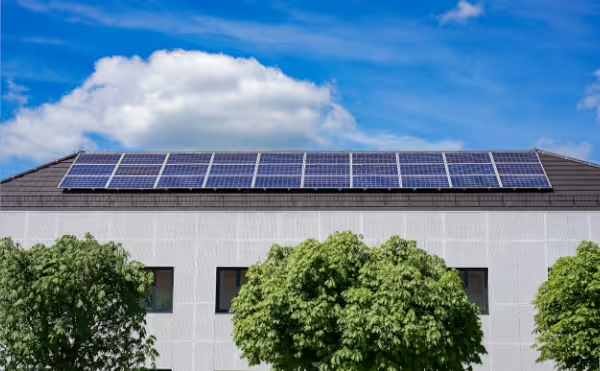
Building-integrated photovoltaics (BIPV) represents a growing trend in urban environments, where solar panels are integrated directly into building materials such as roofs, facades, and windows . This approach not only generates clean energy but also reduces the need for additional land, making it particularly valuable in densely populated areas.
Conclusion: A Bright Future
The future of solar energy is exceptionally bright. The combination of rapidly advancing technology, plummeting costs, supportive policies, and growing energy security concerns is creating unprecedented momentum for solar adoption worldwide. While challenges related to grid integration, storage, and supply chains must be addressed, the industry is well-positioned to overcome them.
Solar energy is no longer just an alternative—it is becoming the cornerstone of the global energy system. With perovskite tandem cells pushing efficiency boundaries, space-based solar opening new frontiers, and costs continuing to decline, the solar age is firmly established . The coming decades will witness the transformation of our energy infrastructure, with solar power at its very heart, delivering a cleaner, more sustainable, and more prosperous future for all.
For businesses and homeowners alike, the message is clear: the time to invest in solar is now. With the industry transitioning from "scale competition" to "value competition," the future belongs to those who embrace innovation and quality . The sun has always been our most abundant energy source; now, finally, we have the technology and the economic rationale to harness its full potential.